Damien Hirst's 5 Biggest Scandals | The Diamond Skull That Was Never Sold
Did Damien Hirst's diamond skull really sell for $38M? Why are his works dated before they existed? 5 controversies to know before visiting MMCA Seoul's 2026 retrospective.
The National Museum of Modern and Contemporary Art, Korea (MMCA) has opened a large-scale retrospective of Damien Hirst. When the news broke, reactions came flooding in from inside and outside the art world. The debate centered on whether it was appropriate for a national institution to bring in an artist who had arguably already peaked in the market, spending roughly 2.3 million USD of public funds to do so. It's rare for a single exhibition to generate controversy that spills beyond the art world into the mainstream press. Whether it was that controversy that drove the marketing, the Hirst exhibition has since drawn long queues of visitors.
Who Is Damien Hirst?
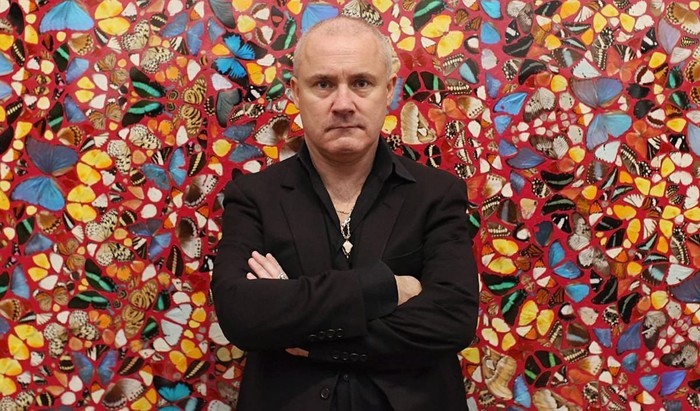
Damien Hirst (1965–) is a British contemporary artist and one of the defining figures of the Young British Artists (YBA) generation. From animals suspended in formaldehyde tanks to spot paintings made up of thousands of colored dots, to a human skull encrusted with 8,601 diamonds — each of his works has managed to shake both the art market and the critical establishment upon arrival. The assessment that he fundamentally reshaped the landscape of contemporary art after the 1990s, and the accusation that he was simply a savvy businessman who knew how to exploit the capitalist system, have followed his name in equal measure ever since.
He also happens to check nearly every box on the list of grievances people have with contemporary art. Paintings he didn't paint himself, tanks filled with dead animals, works that sold for tens of millions based on an idea alone. He consistently ranks at the top of the "why is this even art?" conversation. And yet, despite the unending backlash, the contemporary art world continues to count him among the most important artists of the late 20th century.
This article is meant to introduce five controversies surrounding Damien Hirst — context that might help you digest his exhibition at MMCA before (or after) you walk through it. The show is titled Damien Hirst: No sense of absolute corruption, and it's on view in the first half of 2026. Think of this as a guide for not getting artistically overwhelmed by the art world's most provocative troublemaker.
Five Scandals That Made Damien Hirst, Damien Hirst
The Diamond Skull That Never Actually Sold
Hirst is perhaps the only artist who has used death as subject matter and simultaneously sold that death at the highest price on record. One of the highlights of this exhibition, For the Love of God, is a platinum cast of an 18th-century human skull encrusted with 8,601 diamonds. The skull itself was sourced from a taxidermy shop in Islington, London called Get Stuffed. The original teeth were kept intact and reinserted into the work, so beneath the blinding brilliance of real diamonds, a set of yellowed human teeth stare back at you — an oddly jarring effect.
Hirst initially claimed he financed the production costs of £8 million out of his own pocket. The final bill, however, reportedly ballooned to £15 million (approximately ₩25 billion) once diamond procurement was factored in, covered through a combination of Hirst's own investment, White Cube Gallery, and outside investors. As for the title: it came directly from his mother, who reportedly said, "What on earth are you doing that for, for the love of God?"
The biggest controversy surrounding the work, though, isn't the price — it's whether the sale ever actually happened. In 2007, White Cube Gallery announced that the piece had been sold to an anonymous group of investors for £50 million, or roughly ₩100 billion at the time. Art press around the world ran the story as a record-breaking sale for a living artist. Then, in a 2022 interview reported by artnet, Hirst revealed that the work was still sitting in a storage facility in Hatton Garden, London, co-owned by himself, White Cube, and those same anonymous investors.
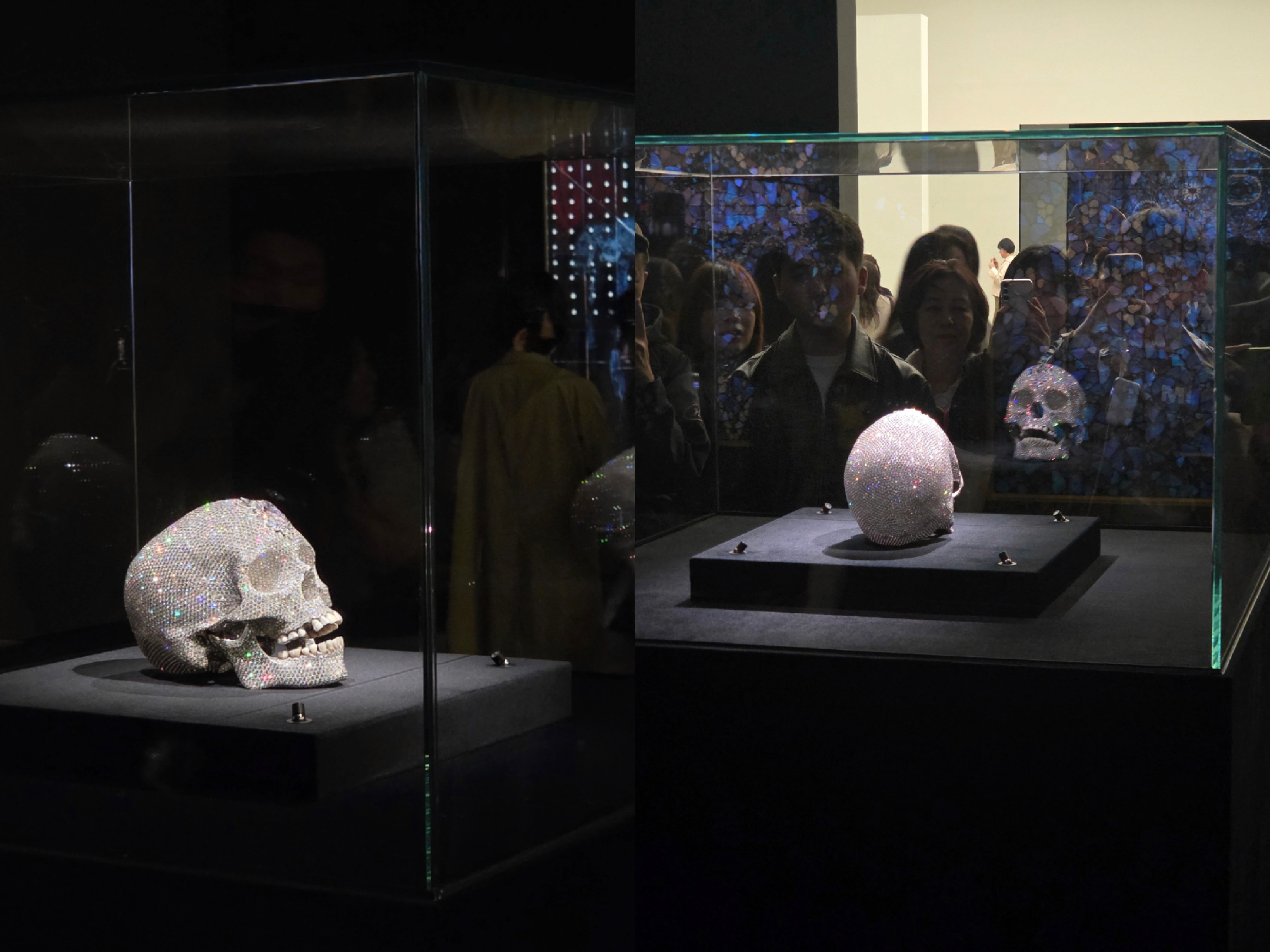
In other words: the work that was announced as sold had never actually been sold. The Art Newspaper noted pointedly at the time that it was "very convenient" that the cash transaction left no paper trail. Some reports went further, suggesting that the "anonymous investor group" was Hirst himself, his business manager, and the owner of White Cube. They made it. They bought it. Hirst had used the announcement of a ₩100 billion sale to validate his own market value — except the sale never happened. That self-proclaimed ₩100 billion work is now sitting behind bulletproof glass at MMCA Seoul.
This episode reveals something fundamental about how prices are made in contemporary art. The value of a work is not determined by materials or labor hours, but by an artist's reputation, market expectation, and sometimes the announcement itself. Even if the transaction never closed, the moment "₩100 billion" circulated in the press, Hirst's market value began moving toward that number. His work is expensive not just because of what it is, but because the price he claimed helped create the value. It's a question that extends beyond Hirst to the entire logic of the contemporary art market. Contemporary art prices, in many ways, behave not unlike stock prices — and in that sense, contemporary art and capitalism are inseparable.
The following September, in 2008, Hirst bypassed galleries entirely and put 218 new works directly to auction at Sotheby's under the title Beautiful Inside My Head Forever. The sale achieved a record £111 million for a single-artist auction. The day it happened was the same day Lehman Brothers declared bankruptcy. At the precise moment the global financial crisis began, Hirst's prices hit their peak. Whether that was coincidence or one final choreographed performance, no one knows for certain. Reading this work means holding all of it at once: the memento mori tradition, the collision of capitalist desire with warnings of death, and the possibility that the transaction itself may have been fiction.
The Work Was Dated Before It Existed
The most widely discussed controversy surrounding Hirst concerns price. But there is another one that cuts just as deep: can an idea alone constitute a work of art?
According to an investigation by the Guardian, some of Hirst's formaldehyde sculptures were listed as works from the 1990s, when they had in fact been physically produced in 2017. Despite being physically created for the first time in 2017, they were dated to a period before the works even existed, on the grounds that the "idea" had originated in the 1990s. The Guardian's reporting also included testimony that Hirst's staff had artificially aged some of the works to make them appear older. When the controversy surfaced, Hirst's team responded that in conceptual art, a date refers to the moment of conception, and that the idea and intention matter more than the physical act of making.
What Is Conceptual Art?
Conceptual Art is a movement in which the idea or concept behind a work is considered more important than its physical execution or craft. It gained momentum in the 1960s, with Marcel Duchamp's readymades often cited as its forerunner. The reason Duchamp's Fountain — a urinal placed in a gallery — was so shocking was not the object itself, but the act of declaring it art. In conceptual art, a work can exist without the artist's direct hand, and even without a visible object at all. Hirst's defense rests squarely on this logic.
Hirst's works, however, unlike Duchamp's Fountain, have a clear and substantial physical form: the formaldehyde tank. The concept matters, but when that concept was made into an object is an entirely separate question. The reason the 1990s date matters is that this was the period when Hirst was at the center of the YBA movement, shaking the art world to its foundations. The same work carries a very different market value depending on whether it was made in the 1990s or in 2017. Whether Hirst's dating practice represents a legitimate conceptual art position or a calculated inflation of market value remains a point of genuine disagreement within the art world. Is listing the year an idea was born, rather than the year a work was made, fraud — or simply how conceptual art works?
The Best One Was Painted by Rachel
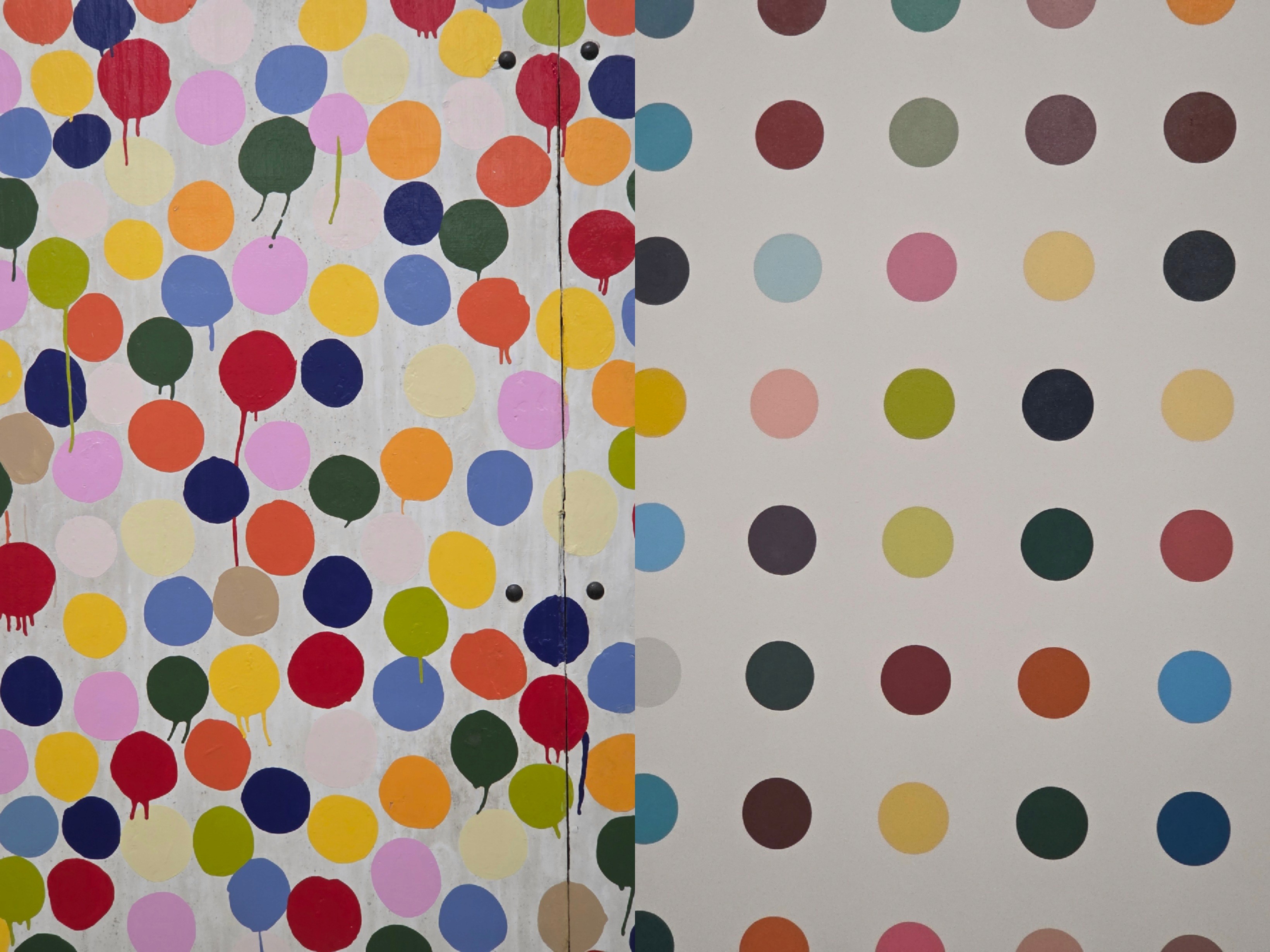
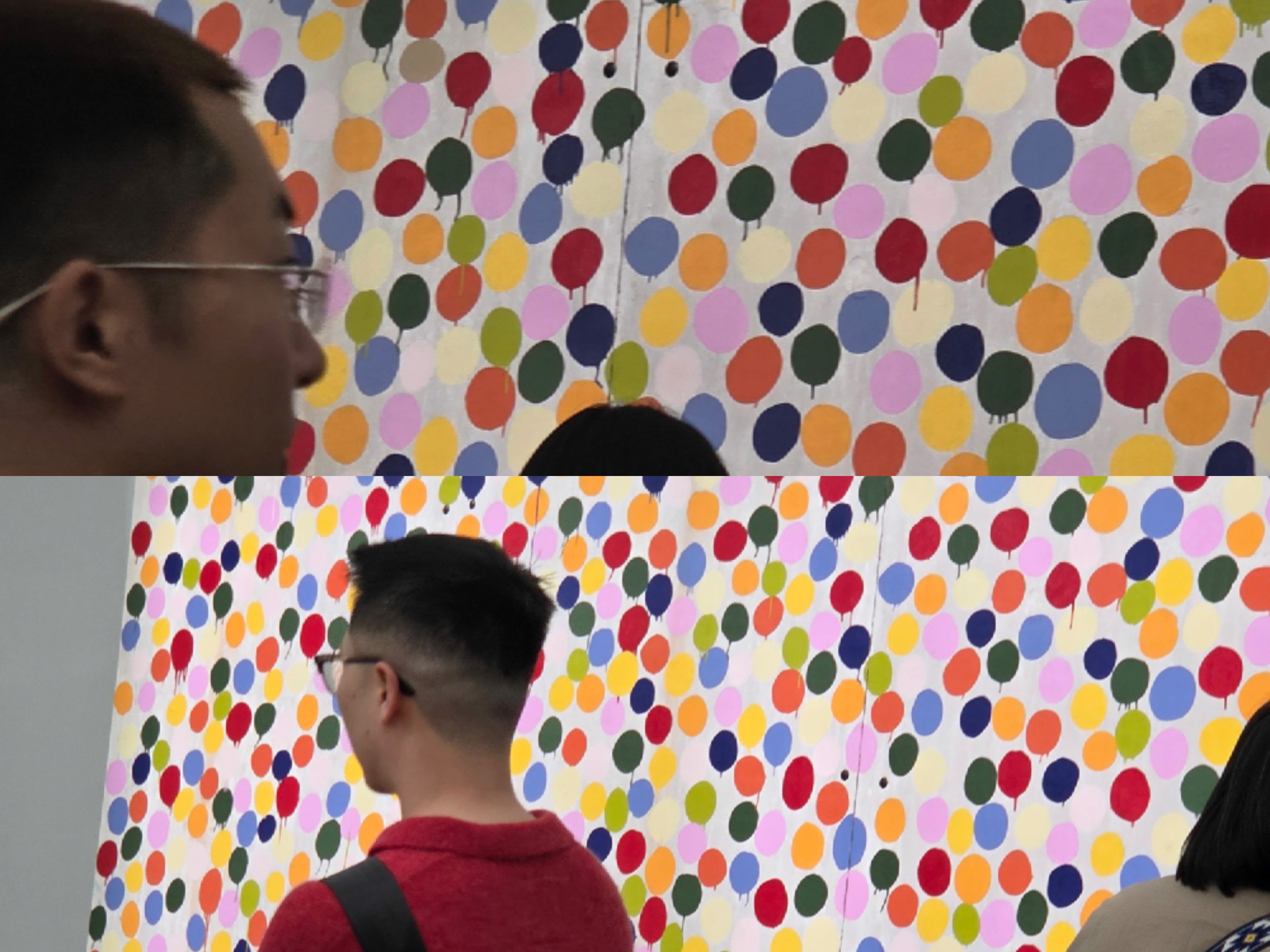
The third controversy is one of the oldest: that Hirst did not personally participate in making some of his works. He has admitted that out of over 1,400 spot paintings, he personally painted only five. His reason was disarmingly honest: his assistants were better at it than he was. He publicly stated, "the best spot painting you can have by me is one painted by Rachel." At the current MMCA exhibition, dozens of spot paintings are on view — and it's impossible to know how many of them Hirst's hand ever touched.
Using assistants is hardly new in art history. Rubens and Rembrandt ran large workshops and completed works collaboratively. Raphael divided production among his pupils. In Korea, artist Ham Kyungah is known for transmitting her designs through Chinese intermediaries to North Korean embroidery workers, who stitch the works by hand before returning them.
Where Hirst's case differs is in the nature of the work itself. Rubens's workshop and Ham Kyungah's embroidery practice both require exceptional technical skill — the kind of craftsmanship that cannot simply be swapped out. Spot paintings, by contrast, involve repeating uniform dots of color at consistent intervals: technically straightforward by comparison. The fact that the assistant could always be a different person, and that Hirst chose to delegate a relatively simple task for the sake of convenience, is what makes his case feel distinctly more jarring.
Smiled for the Camera, holding a Severed Head.
If this exhibition at MMCA could be summed up in a single word, it would be: death. Hirst's obsession with mortality began early. He has spoken about sneaking into a morgue in Leeds as a teenager and photographing corpses. That experience, he has said, planted the seed for the preoccupation with death that runs through his entire body of work.
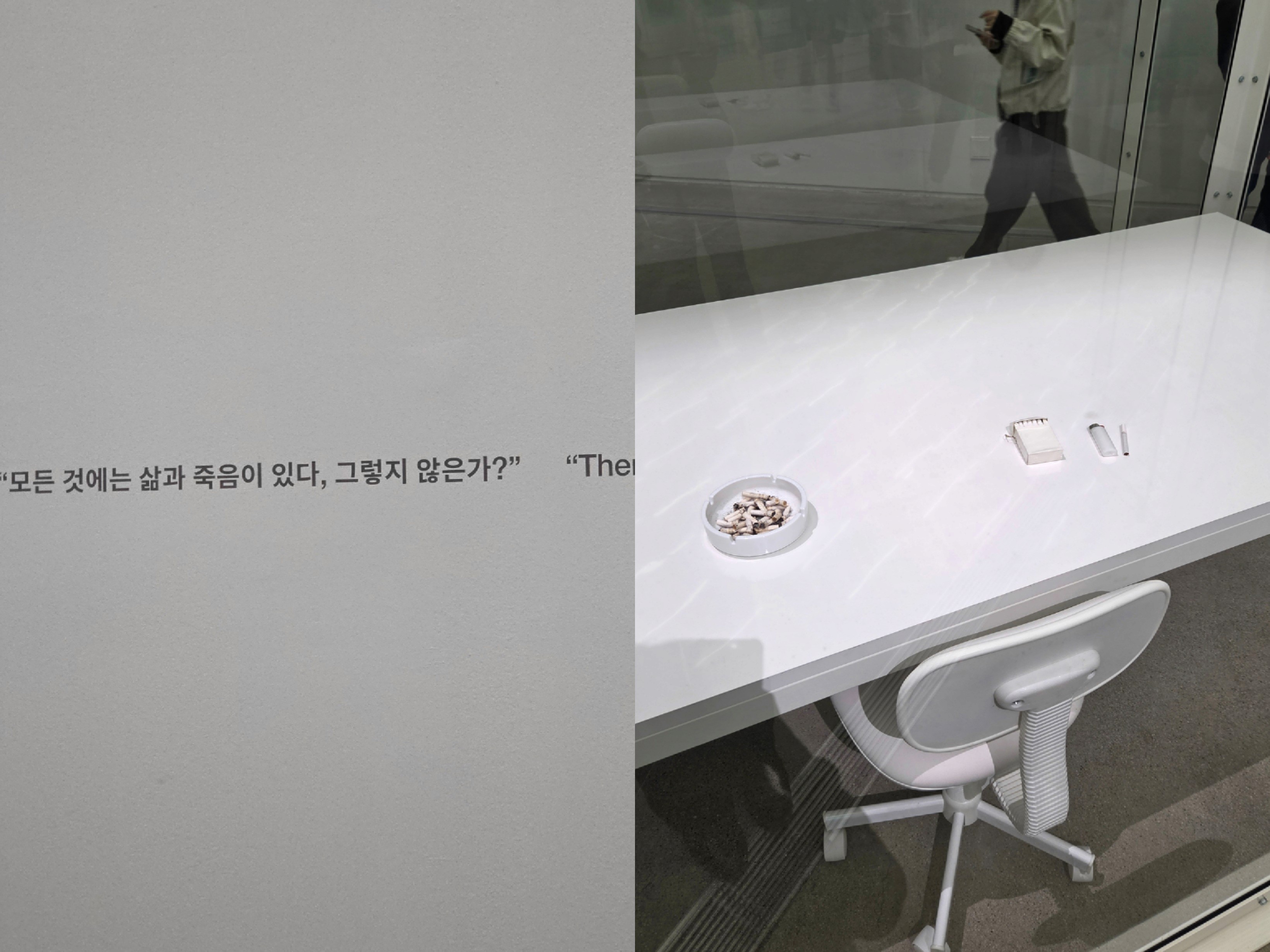
But for Hirst, death was never merely a personal fixation. The year he emerged on the world stage was 1989 — the year the Berlin Wall fell and the Soviet Union began to collapse. The YBA generation appeared at the precise moment capitalism declared itself the only winner. Where previous generations of artists had chosen to resist or critique capitalism, this group took a different approach. They treated art not as a noble ideal but as an existential game played inside the capitalist system — one that required survival and victory. Staring directly at death in that context was not simply provocation. It was the most direct way to touch the anxiety of the age.
Who Were the Young British Artists (YBA)?
The Young British Artists were a loose group of artists who emerged in Britain from the late 1980s through the 1990s, many of them graduates of Goldsmiths College of Art, with Hirst at the center. Their work was provocative, commercial, and media-savvy. British advertising mogul Charles Saatchi began collecting their work aggressively and propelling them into the international market — that was the origin of the YBA myth. From the very beginning, art and capital were co-conspirators.
MMCA chose as the very first work in this exhibition a photograph of a young Hirst grinning while cradling a severed human head. That single image tells you everything about how the curators have chosen to read him. No further explanation of why it's controversial is necessary — the work's existence is the controversy. The final section of the first gallery also includes a photograph depicting a gunshot suicide. It is shown with pixelation, viewable in full only via QR code. The exhibition is not officially classified as adult-only, and children were present in the gallery during my visit. The space itself poses the question of where Hirst has drawn the line — and whether anyone else gets to decide.
The Shark Died Twice
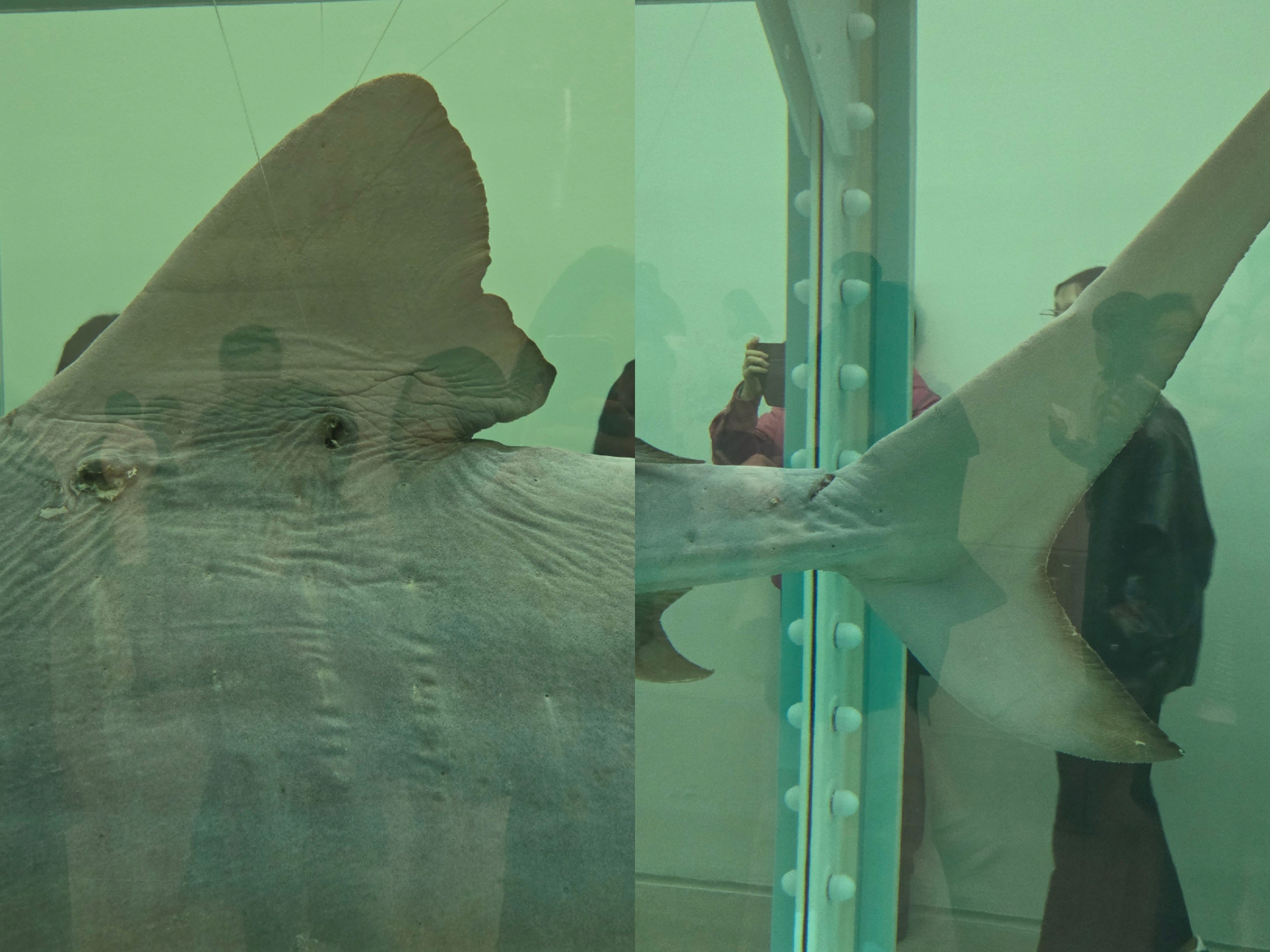
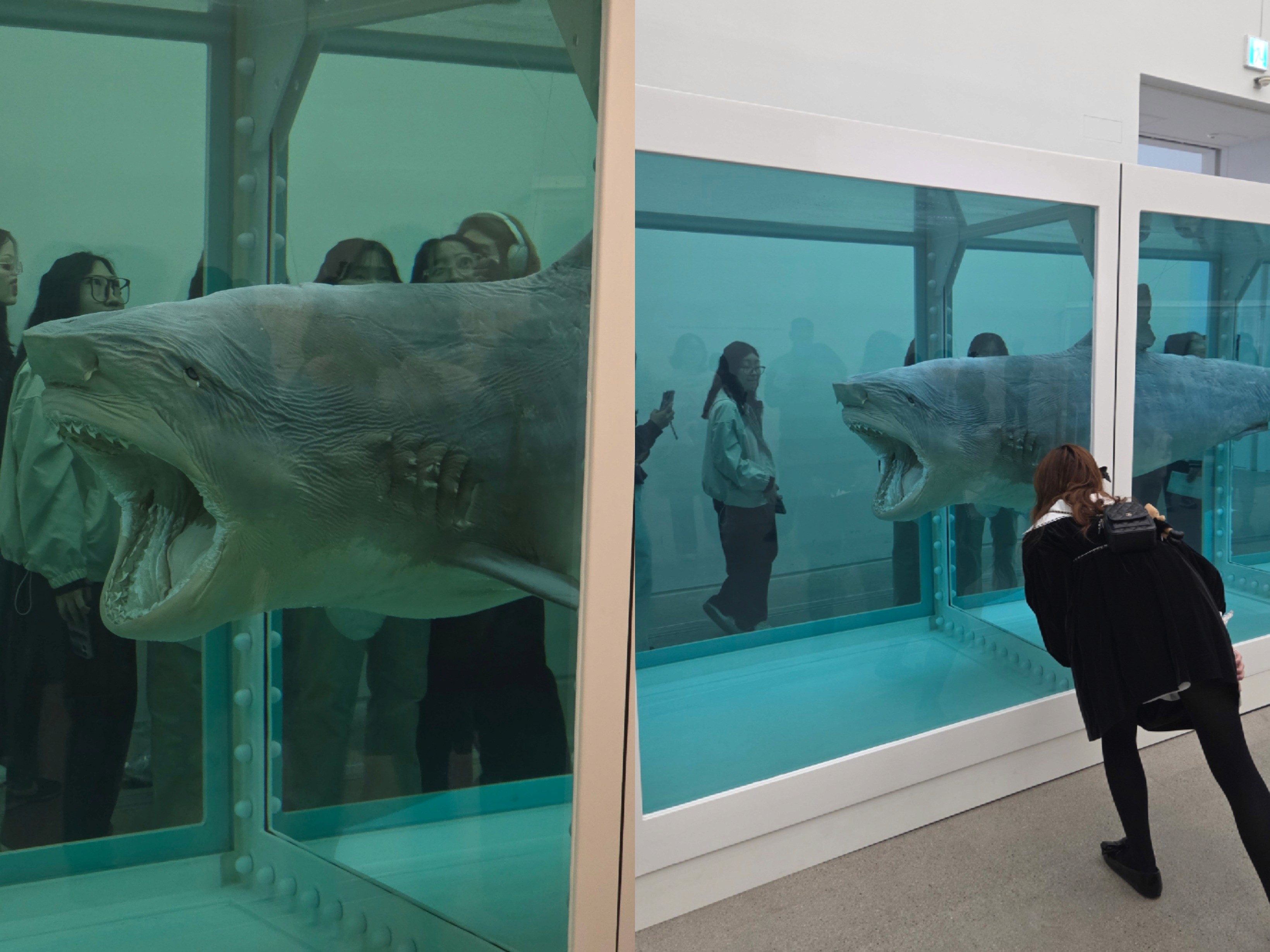
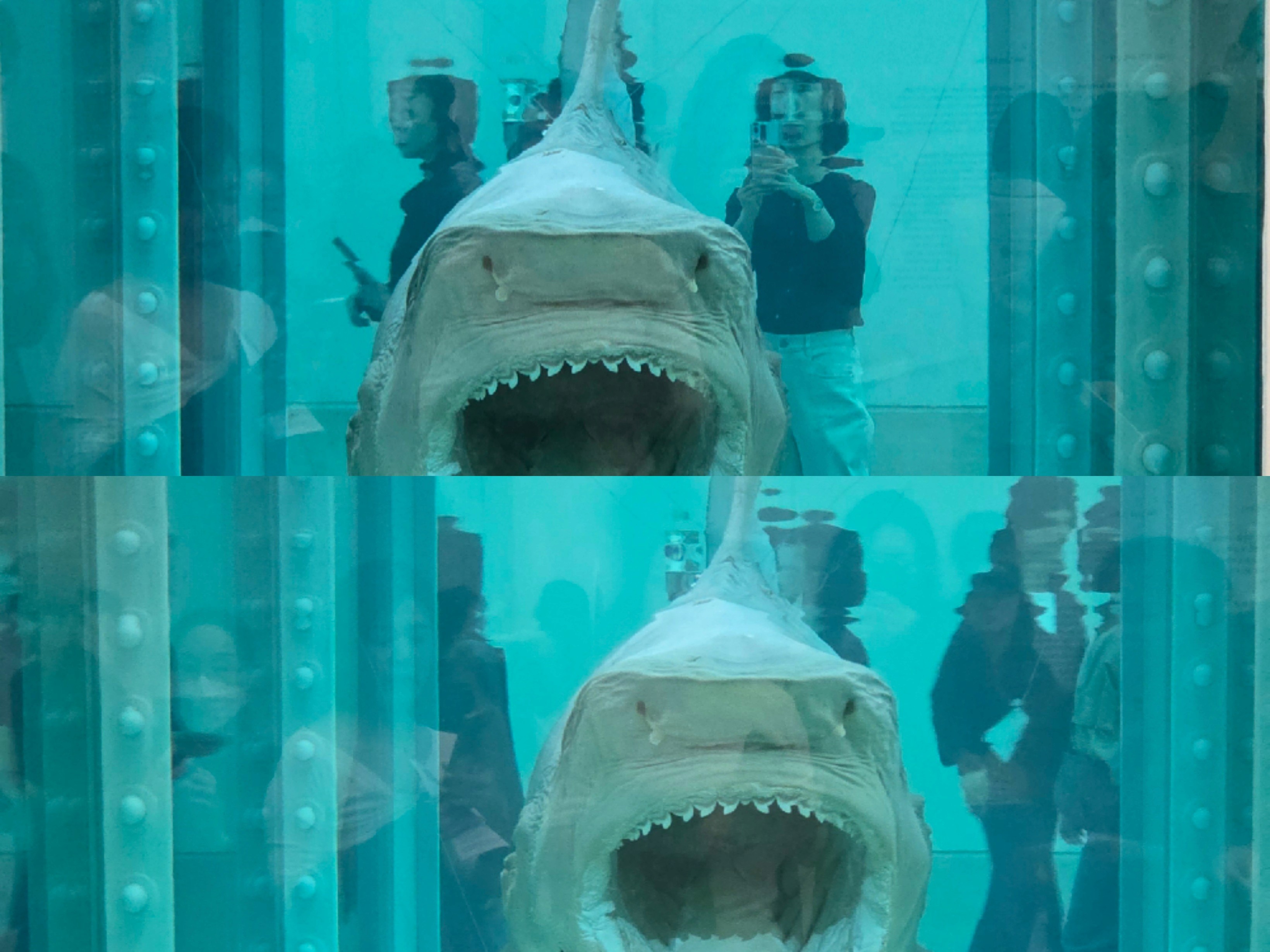
Hirst attempts to confront us with death through the deaths of animals. The Physical Impossibility of Death in the Mind of Someone Living, on view at this exhibition, is his most famous work: a great white shark over four meters long, suspended in a formaldehyde tank. When it was first shown in 1991, it turned the art world on its head. What is less commonly known is that the original shark deteriorated over time and was replaced with a new one in 2006. The work that tried to preserve death could not escape death itself.
The shark died, was reborn as a Damien Hirst artwork, gained a kind of immortality, then slowly wrinkled and yellowed and was eventually replaced by a fresher corpse. MMCA installed this enormous work in sections. The installation process was documented and can be viewed on MMCA's official YouTube channel.

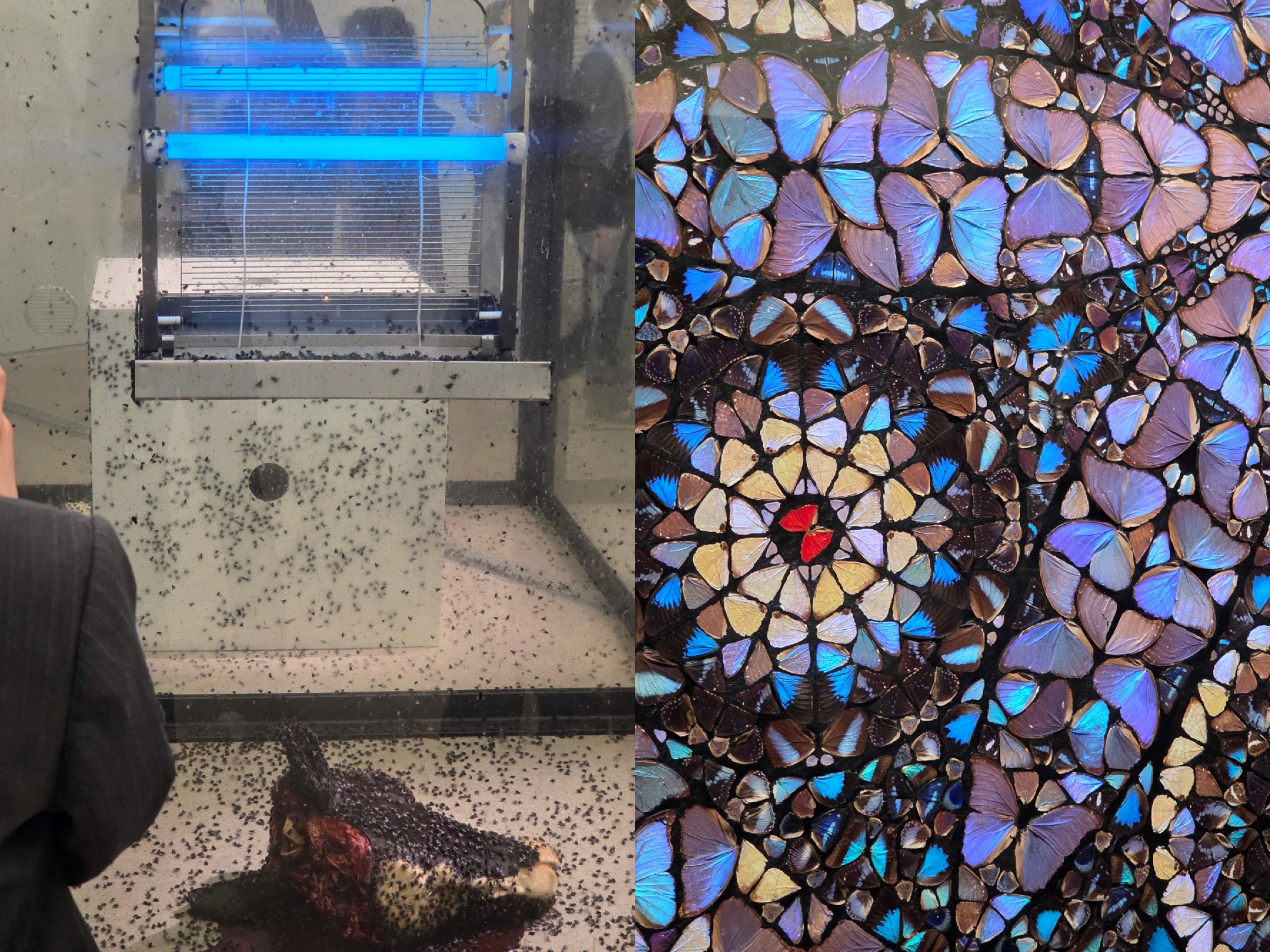
Sharing the same gallery is A Thousand Years, which presents death in an even more unmediated form. Inside a glass case, a rotting cow's head sits surrounded by swarming flies. The flies feed, lay eggs, hatch, and die. This cycle continues in real time throughout the entire exhibition run. Where the shark freezes death in formaldehyde, A Thousand Years lets death keep moving. Hirst places preservation and ongoing decomposition side by side. To force humans to face death, he uses the deaths of animals as an active medium. Human corpses have not been mounted for display — but dead animals are easy to find throughout the galleries.
What Are Memento Mori and Vanitas Painting?
Memento mori is Latin for "remember that you will die." This tradition, which began in medieval Europe, used images of skulls, rotting fruit, and guttering candles to remind viewers of life's impermanence and death's inevitability. It was not simply about depicting death — it was a device that asked: how should you live, given that you will not live forever.
Memento mori is Latin for "remember that you will die." This tradition, which began in medieval Europe, used images of skulls, rotting fruit, and guttering candles to remind viewers of life's impermanence and death's inevitability. It was not simply about depicting death — it was a device that asked: how should you live, given that you will not live forever.
These works were also known as vanitas paintings, from the Latin word for "vanity" or "emptiness." No matter how beautiful a flower, it will wilt; no matter how brilliant a life, it ends — that was the message encoded into every corner of the canvas. Pieter Claesz's Vanitas Still Life, Philippe de Champaigne's painting of a skull beside a tulip and an hourglass, Hans Holbein's The Ambassadors with its anamorphic skull hidden on the floor — these are the touchstones of the tradition. What Hirst did was translate that centuries-old practice into the language of the 21st century: formaldehyde and diamonds.
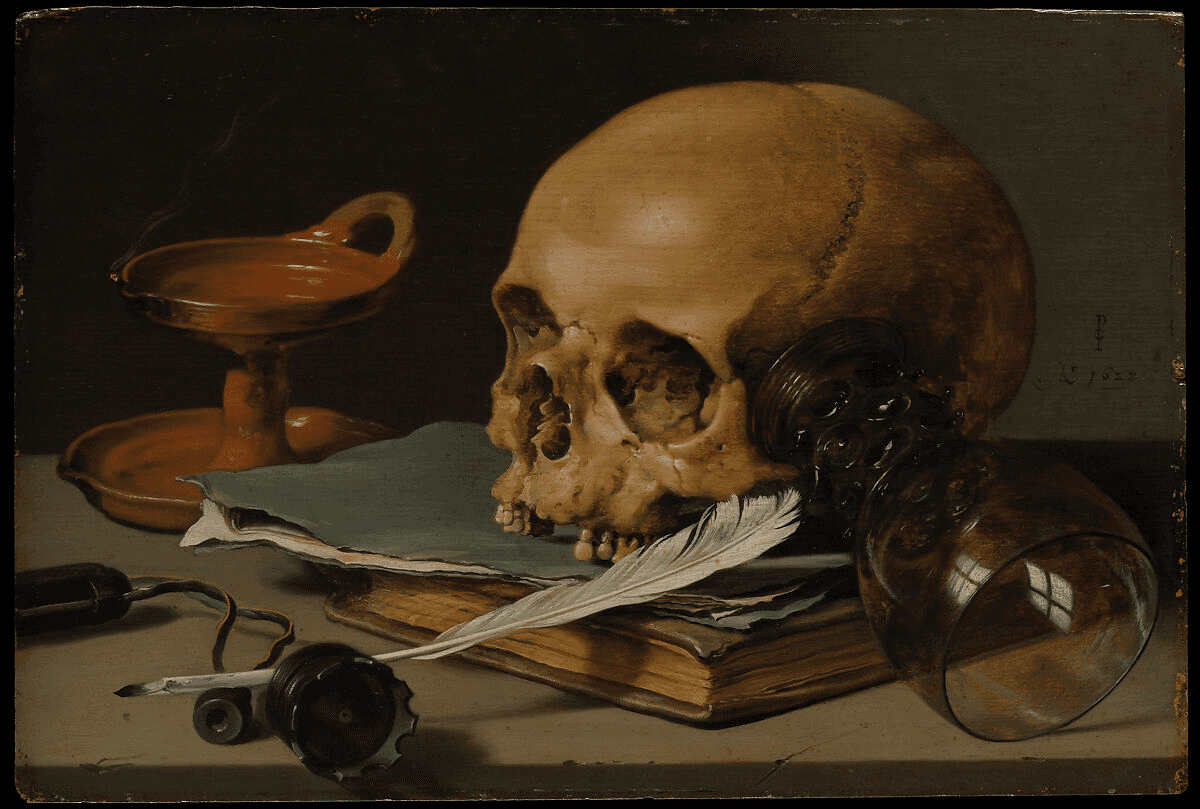
For the Love of God is where that tradition reaches its most extreme form — a real human skull surrounded by dead animals, covered in diamonds to transform the macabre into art. Standing before it, you encounter Hirst's method at its most concentrated: the warning of death and the drive of capitalist desire colliding inside a single object. Or you might simply appreciate the remarkable way diamonds catch the light.
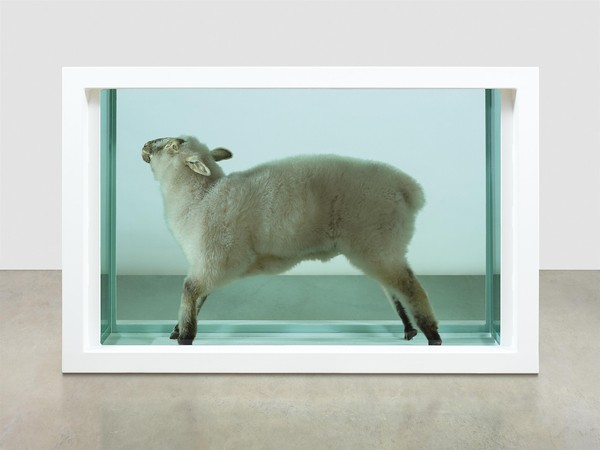
Not on view at this exhibition is Away from the Flock, a young lamb preserved in formaldehyde — a work that layers religious sacrifice imagery over the memento mori tradition. If Hirst talks about death in order to bring death physically into the museum, one wonders whether his ultimate dream is to exhibit his own corpse. Though his apparent fascination with pharmaceuticals and surgical instruments suggests otherwise — there's a certain irony in the fact that those who spend their lives studying death, like Schopenhauer, often die of natural causes.
Damien Hirst: Somewhere Between Charlatan and Master
Knowing all of this and then walking through a "major retrospective" leaves you genuinely uncertain about whether you can accept him as an artist at all. Is Damien Hirst a visionary? A meticulous entrepreneur? The suspicion that even this question is something Hirst designed is hard to shake.
Is he a fraud who made money pretending to critique capitalism, or an artist who pushed the logic of capitalism to its limits in order to expose it? If you leave the exhibition still unsure whether he's an artist or a businessman, that confusion is probably the closest thing to the answer he intended. If "master" feels like too generous a word, "art world troublemaker" or "born-to-be artist" might do just as well. I hope these five controversies serve as a guide — a way to walk through this exhibition without letting the shock and spectacle be the only thing you take home.
보나 로그 아티클 더보기