How Loop Turned Earplugs into a $220M Brand
An honest one-year review of Loop Earplugs, plus the story of how two Belgian engineers turned a boring category into a $220M brand and how Loop entered Korea.
Loop Earplugs: The "Luxury" Earplug Brand
Hi, I'm Bona! Have you ever used those orange foam earplugs? The 3M ones you squeeze, stick in your ear, and wait for them to slowly puff back up. They'd get wrinkly after a use or two, and there was never a good place to keep them, so they'd just roll around until they ended up in the trash. I used them a few times back in my exam-prep days, but they got grimy so fast that I always tossed them after one or two uses.
So earplugs were something I only reached for on special occasions, like when they were handed out on a flight or during exam season. The rest of the time, they simply didn't exist in my life. Everyone knows earplugs, but nobody loves them. That was the category. And yet, a brand found a business opportunity in this very market. It's Loop Earplugs, the brand that's been aggressively running performance marketing in Korea lately (they show up in my Instagram stories all the time) and has grown to hundreds of millions of dollars in annual revenue. As for me, I've now been a Loop user for a full year. So here's my honest review of the "luxury" earplug, along with the story of how Loop grew.
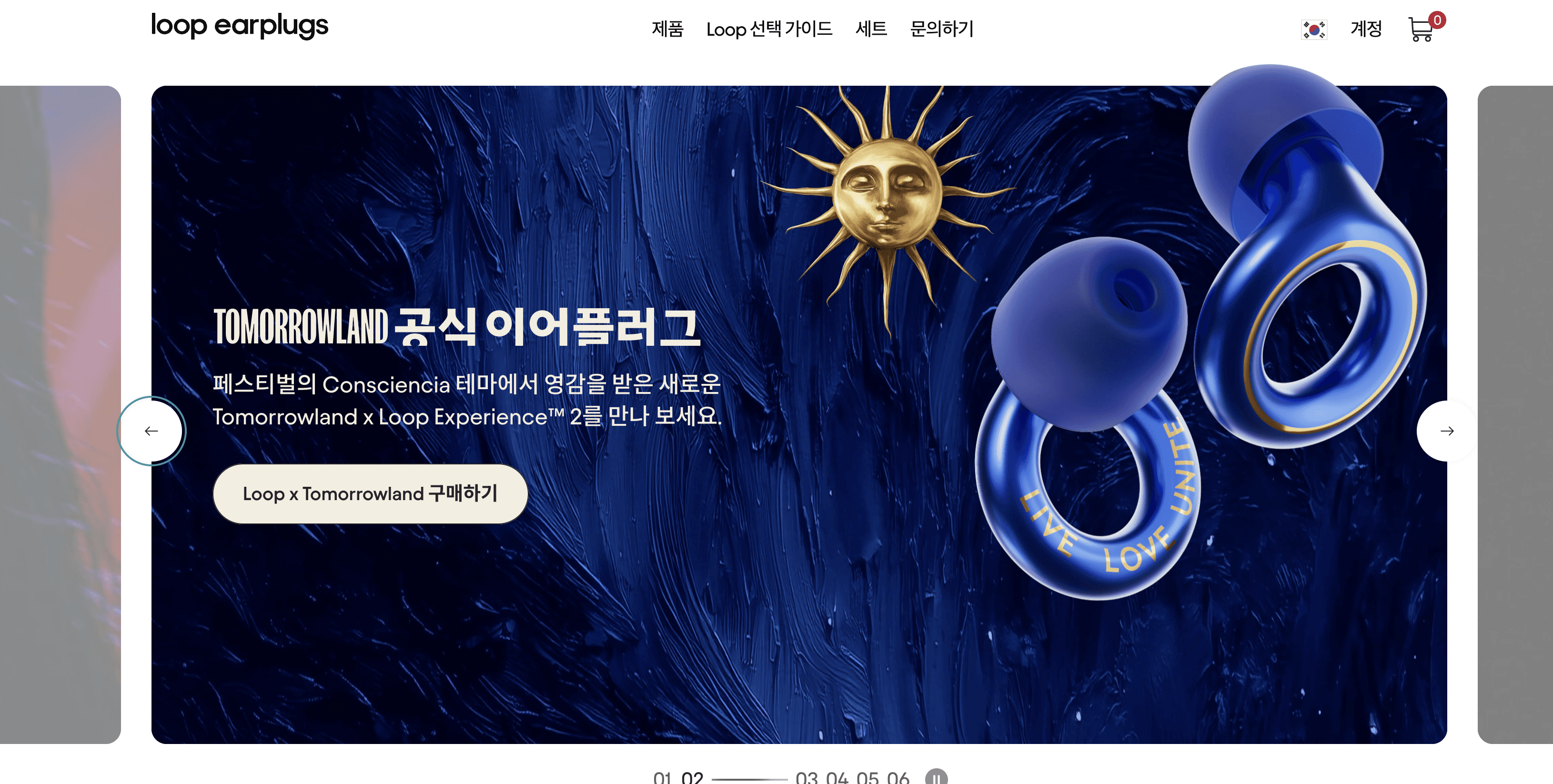
(caption) The Loop Earplugs website homepage. Loop is the official earplug of Tomorrowland, the world's largest EDM festival.
Two Engineers Who Partied Their Way into Tinnitus
Loop was founded in Belgium in 2016. Belgium takes its festivals seriously. The small town of Boom hosts Tomorrowland, the world's largest EDM festival, every year. Loop's co-founders, Maarten Bodewes and Dimitri O, grew up in exactly this culture.
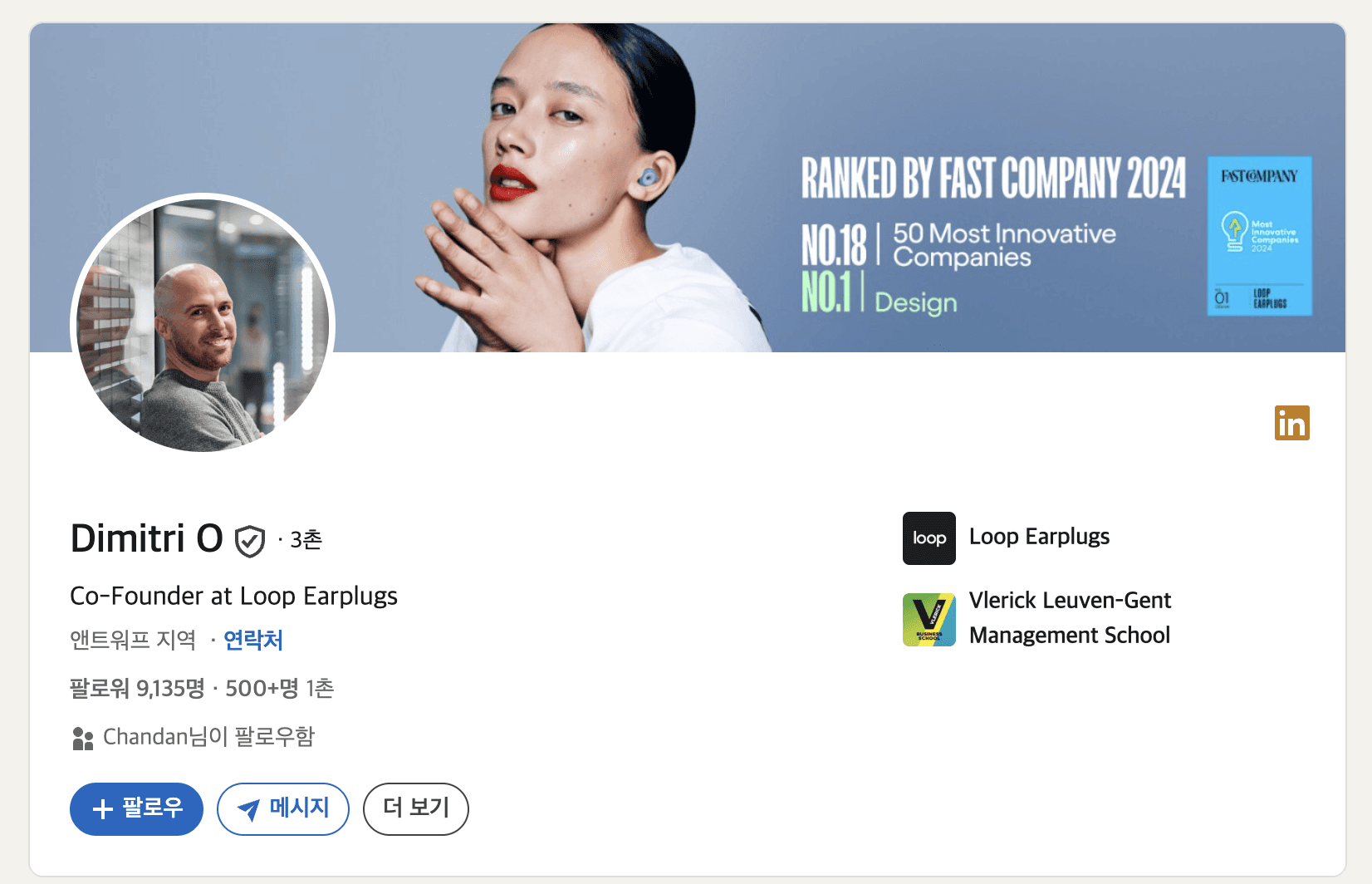
(caption) Co-founder Dimitri O's LinkedIn, where you can trace Loop's growth story.
The two engineers, friends since childhood, loved festivals so much that they ended up with tinnitus. From their late twenties, a ringing in their ears would last for days after every concert. But quitting festivals wasn't an option. They tried every earplug on the market and found nothing that delivered all three things they wanted: noise reduction, comfort, and design. So the two eventually quit their jobs and decided to build a festival-ready earplug themselves.
In one interview, Dimitri O put it simply: you dress up to go out, so why stick ugly foam in your ears? That's why Loop was built to stand out on design as much as function. The earplugs are shaped to look like jewelry. Festivals are as much about dressing up as they are about the music, and Dimitri O clearly cared about the look as much as the sound.
In the end, Loop was born from a simple question: sunglasses protect our eyes from UV rays and count as fashion, so why is there no beautifully designed product protecting our ears from noise? In a market where ugly disposables were the default, it was a shift in perspective: earplugs could be accessories. Fun fact: the two founders still go to Tomorrowland every year, except now they go to sell Loops at their own booth instead of just attending.
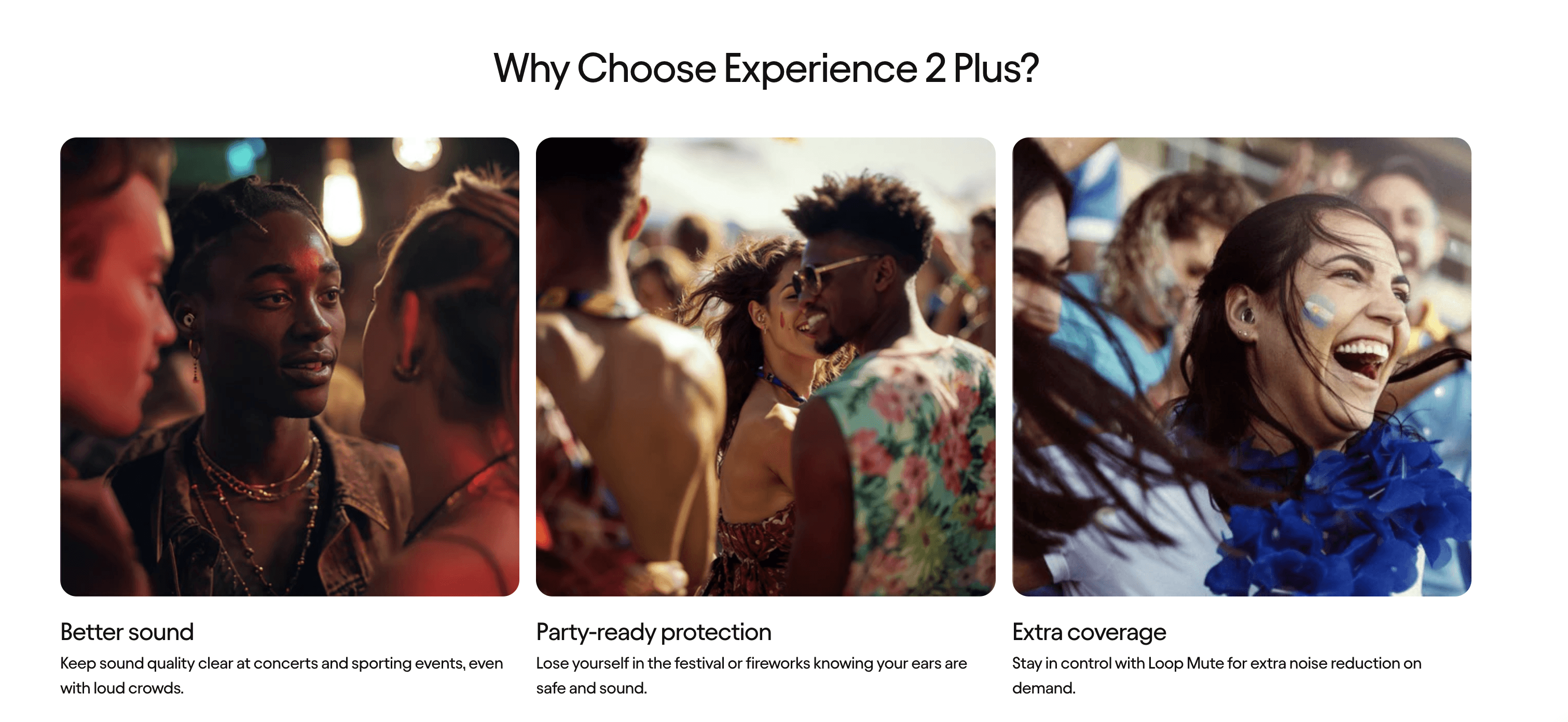
(caption) The product page for Loop Experience 2 Plus, the festival line.
Two Weeks from Bankruptcy to a $220M Earplug Brand
But in 2020, an unexpected crisis hit the brand that had launched as a festival earplug: COVID. Festivals and concerts stopped entirely, and sales collapsed along with them. Co-founder Bodewes later recalled that at one point, the company was just two weeks away from running out of money. Loop had gone all-in on one single use case, festivals, and when that use case vanished overnight, so did the business.
But during this period, the two founders noticed something interesting. Even with festivals gone, people were still using Loops. For sleeping. For focusing while working from home. For surviving the noise of raising kids. A product built for festivals was being reinvented as an everyday essential, right in the hands of its customers. Loop didn't miss the signal. They repositioned the product around everyday situations like sleep, focus, noise sensitivity, and parenting, and shifted to a D2C-first model. After this pivot, Loop's growth curve changed completely.
4.5x in a Single Year: Loop's Revenue Growth Story
Here's what the numbers look like. In 2022, Loop hit €42 million in revenue, up 350% year over year. Measured from 2018, that's a growth rate of 15,275%, making it the fastest-growing tech company in Belgium. Revenue climbed to €126.5 million in 2023, then to around $220 million in 2024. Today, Loop serves over 14 million customers across more than 150 countries. It's the official earplug partner of Coachella and collaborates with McLaren F1. In late 2025, the brand entered 600 Target stores across the US, marking its first big move into physical retail. And thanks to low production costs, Loop has been profitable every year since 2020. Imagine deciding to sell a pair of earplugs for $40 and actually pulling it off. The growth potential of low-COGS consumer products is genuinely staggering.
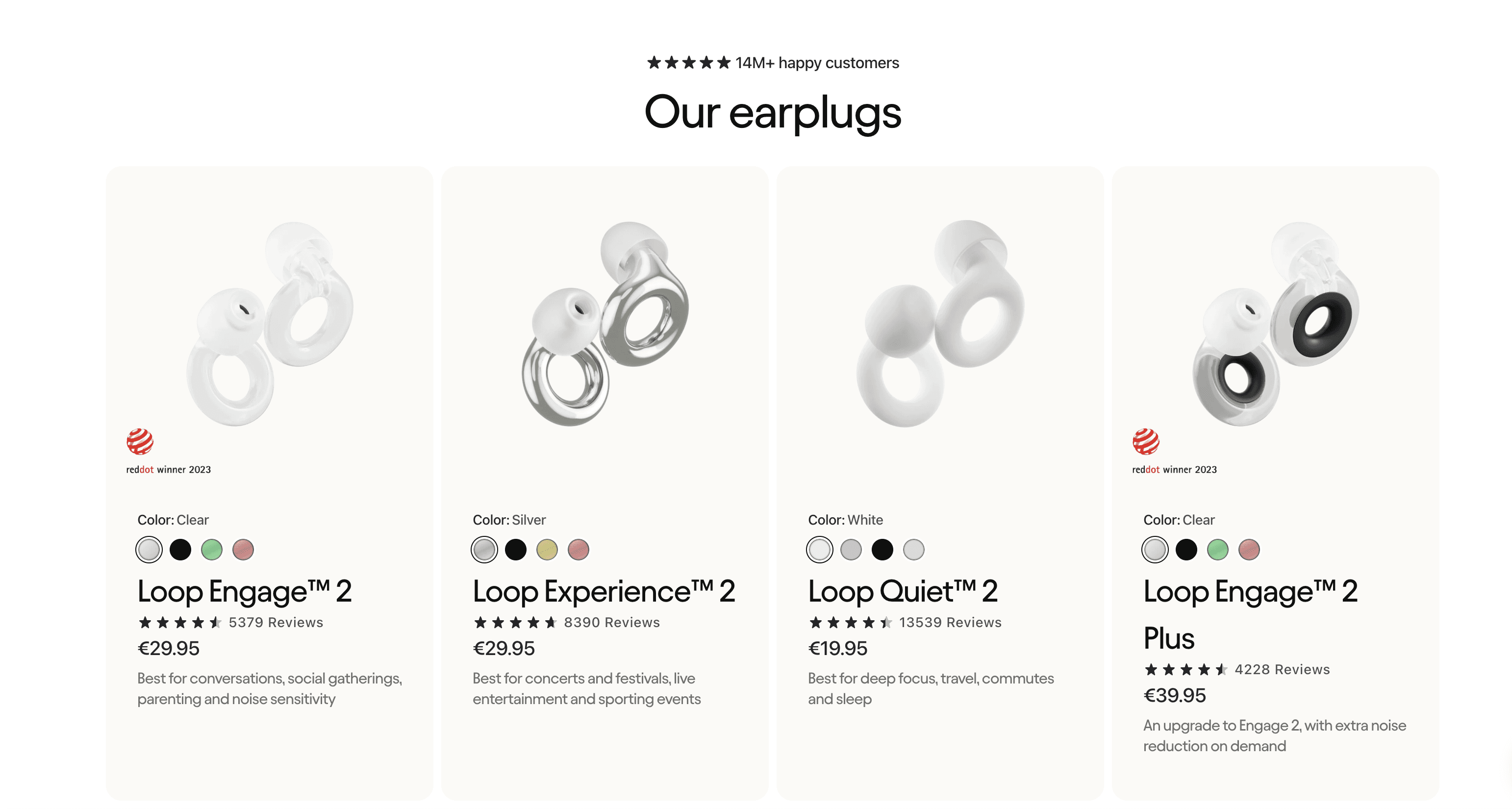
(caption) Loop's main product lineup. Prices start at around $30 to $40 for the entry line.
To Buy or Not to Buy: The $40 Earplug Dilemma
Before Loop, I was a Sony headphones person. I'm sensitive to noise when I work, so I'd been using the Sony WH series for years, widely considered top-tier for noise canceling. No complaints about performance. The problem was portability. The headphones are bulky, and the latest WH model doesn't fold, so I kept tossing them into my bag and damaging the headband over and over. Right when I started shopping for a replacement, a Loop ad caught my eye. The brand wasn't new to me, since I'd first come across Loop as a growth case study in startup articles. But when it came to actually buying one, the hesitation kicked in. Forty dollars for an earplug? For someone with memories of orange foam, that price was hard to swallow. And once I'd clicked that ad page, Loop followed me around my Instagram stories for months. After a solid three months of deliberation, I finally caved and bought the cheapest line.
While deliberating, I dug into Loop's product pages. Here's what's interesting: even as a premium earplug, Loop doesn't advertise "we block noise." They say "we reduce noise." You might think, it's this expensive and it can't even block everything? But Loop actually turns not blocking all the noise into a selling point.
According to Loop, their earplugs don't simply plug your ears. They filter sound through an acoustic channel modeled after the structure of the ear canal. The details vary by model, but the core function is keeping the balance of sound intact while lowering the decibels. My guess is that Loop's festival origins made this possible. It let them test whether "noise reduction," rather than the "total blocking" consumers had always expected from earplugs, could win in the market. The one I bought, the Loop Quiet Sleep 2, reduces noise by up to 24dB with soft silicone tips. Unlike foam earplugs, you can wash it with water and keep using it, so with slightly trembling hands, I went for it.
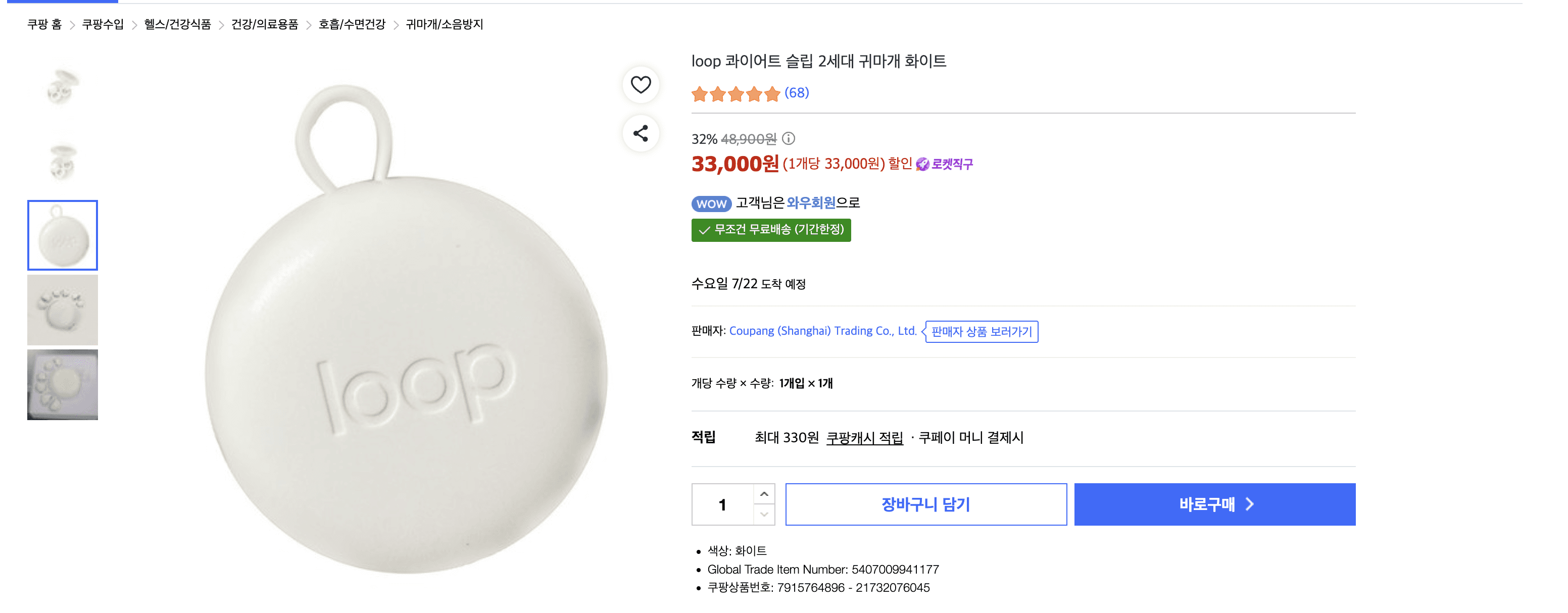
(caption) The Loop Quiet Sleep 2. It was around $40 when I bought it, and it's recently been discounted to the $25 range. (Suddenly looks like great value 😭)
One Year with Loop: My Honest Review
Verdict first: I'm satisfied. It's worth the money. In the early days, though, what bothered me was the sound of my own body. Swallowing, my neck moving, my own breathing — all of it suddenly became noticeable. But after a few days, I adjusted. Now, whether I'm at the office or working alone at a cafe, Loop is non-negotiable.
To be fair, if we're talking pure noise blocking, noise-canceling headphones still win. Turn on ANC, add music, and the outside world basically disappears. Loop is better described as turning the volume of the world down rather than erasing it. And yet, the reason I keep reaching for Loop over my headphones comes down to portability and durability. I keep the case in my pencil pouch and pull it out whenever I need it, so it naturally gets more use. And since wearing Loop while working has become a habit, putting them in somehow feels like flipping a focus switch, which keeps the habit going.
One more thing. When I wear headphones or earbuds at a cafe with music on, the cafe's background music and my own music overlap, and my brain feels like it's being split in two. With Loop, the cafe music just gets quieter, like a lo-fi focus playlist on YouTube, which I love. If you work from cafes often, whether you're a remote worker, freelancer, or student, I genuinely recommend it. I can't speak for the pricier models, but if you use the cheapest entry line for over a year like I have, it beats foam earplugs on value.
How Loop Entered Korea: A Look at Its Go-to-Market Strategy
As a marketer, I've also been watching how Loop entered Korea with great interest. Loop currently runs an official Korean website with full Korean localization, domestic shipping, and free 14-day returns. Inventory sits in Korea and ships within one to three business days, which removes the delivery friction you'd normally expect from an overseas D2C brand.
Interestingly, Loop doesn't seem to run Korea through its own local entity. Based on the contact details on the Korean site, it appears to operate through WPIC, an agency specializing in Asia market entry. It's a lean, pragmatic GTM playbook typical of today's global D2C brands: minimize the risk of direct entry while keeping the local commerce experience up to native standards. On top of that, Loop runs aggressive performance marketing centered on Instagram, which keeps pulling in people like me who come through ads. Occasionally the translated ad creative reads a little awkwardly in Korean, but nothing deal-breaking. The Korean site has even posted notices about products selling out due to higher-than-expected demand. (Loop has since officially launched on Coupang, Korea's largest e-commerce platform, making it much more accessible.)
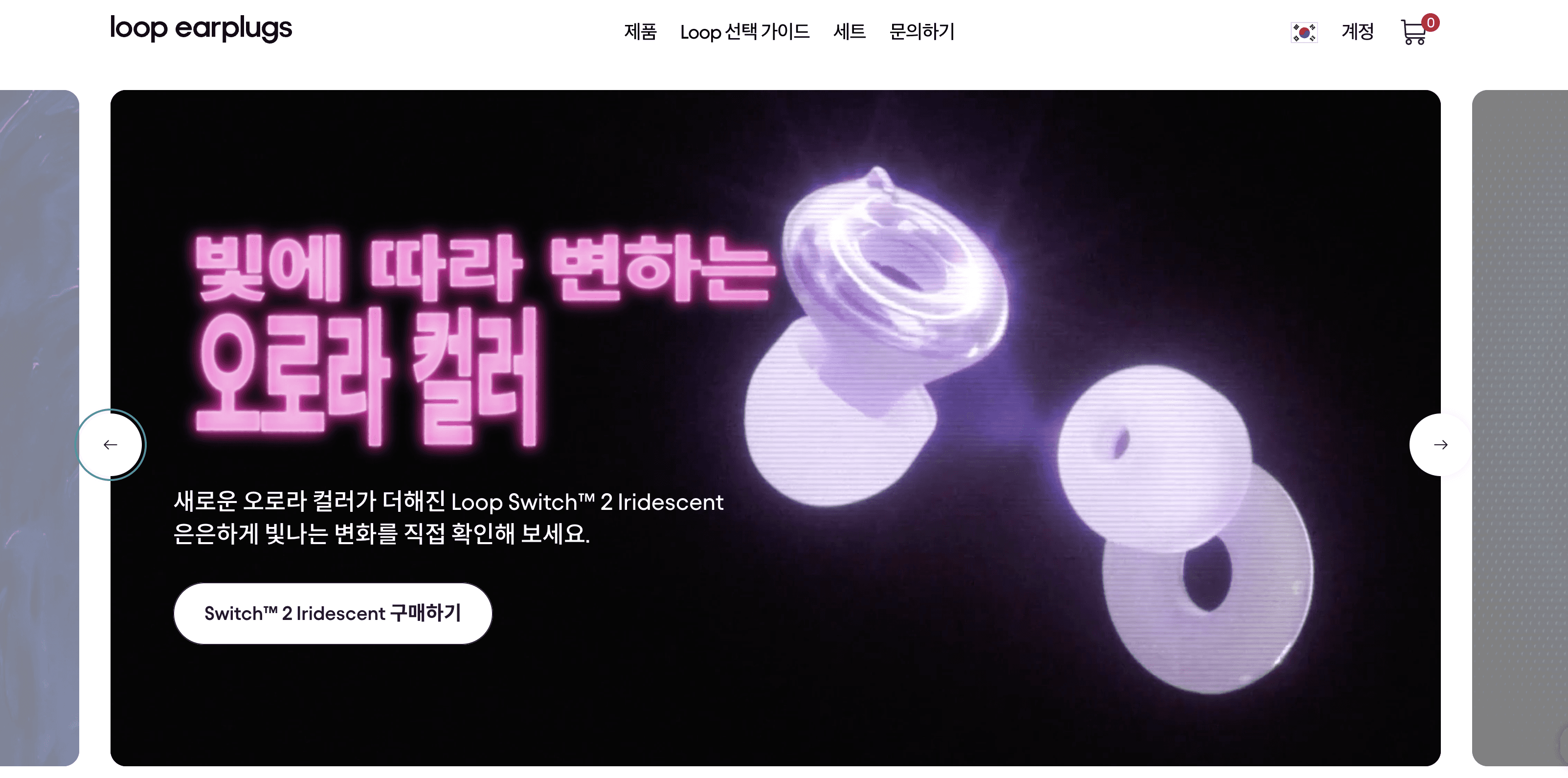
(caption) The fonts on Loop's official Korean website feel slightly off in places... but honestly, for a global brand, their Korean branding, marketing, and GTM execution is impressive 👍
Here's where it gets interesting, though: the context in which Koreans buy Loop seems to differ from its home market. Loop's roots are in festivals, but at Korean festivals, the brand doesn't have much of a presence yet. Instead, the response is coming from the sleep and focus side. I've noticed it going viral among people who struggle to focus due to ADHD tendencies, and in Korean parenting communities, where it comes up in conversations about household noise and kids studying for exams. In a society where competition is a way of life, noise reduction isn't a tool for play. It's a tool for enduring and focusing. There's something bittersweet about that. The same product selling for entirely different reasons in different markets, that alone makes Loop's Korean expansion a case worth watching.
Can Loop Become the Gentle Monster of Earplugs?
So what's next for the brand that turned earplugs into a $220 million business? Looking at Loop's website, the brand used to hold a premium price point with a value proposition built on hip, beautiful design, but lately it seems to be tilting slightly toward functionality.
My read is that the original plan was to follow the Gentle Monster playbook. Gentle Monster is a Korean eyewear brand that grew by redefining sunglasses, a product with fairly low production costs, as a mid-to-high-end fashion item. Loop seemed headed the same way with design and self-expression. But positioning earplugs as a fashion statement turned out to be harder than doing so with sunglasses. Fashion positioning promises a higher price ceiling than functional positioning, which is likely why Loop invested in celebrity and influencer campaigns, including a collab with Harry Styles' beauty brand. But without an explosive response, the brand now appears to be preparing a functional expansion instead.
That brings us back to the ADHD and focus market I mentioned earlier. The trade-off here is real, though. To go deep into focus and sensory sensitivity, the value proposition has to shift from design to function and trust, moving closer to medical-device territory. And the moment that happens, the premium pricing sustained by a hip brand image becomes hard to defend. Perhaps that's why prices have come down noticeably. I remember products priced above $70 not long ago, but looking at Coupang now, Loop seems to have concluded that Korean consumers' price ceiling is around $70 and repriced everything below that line.
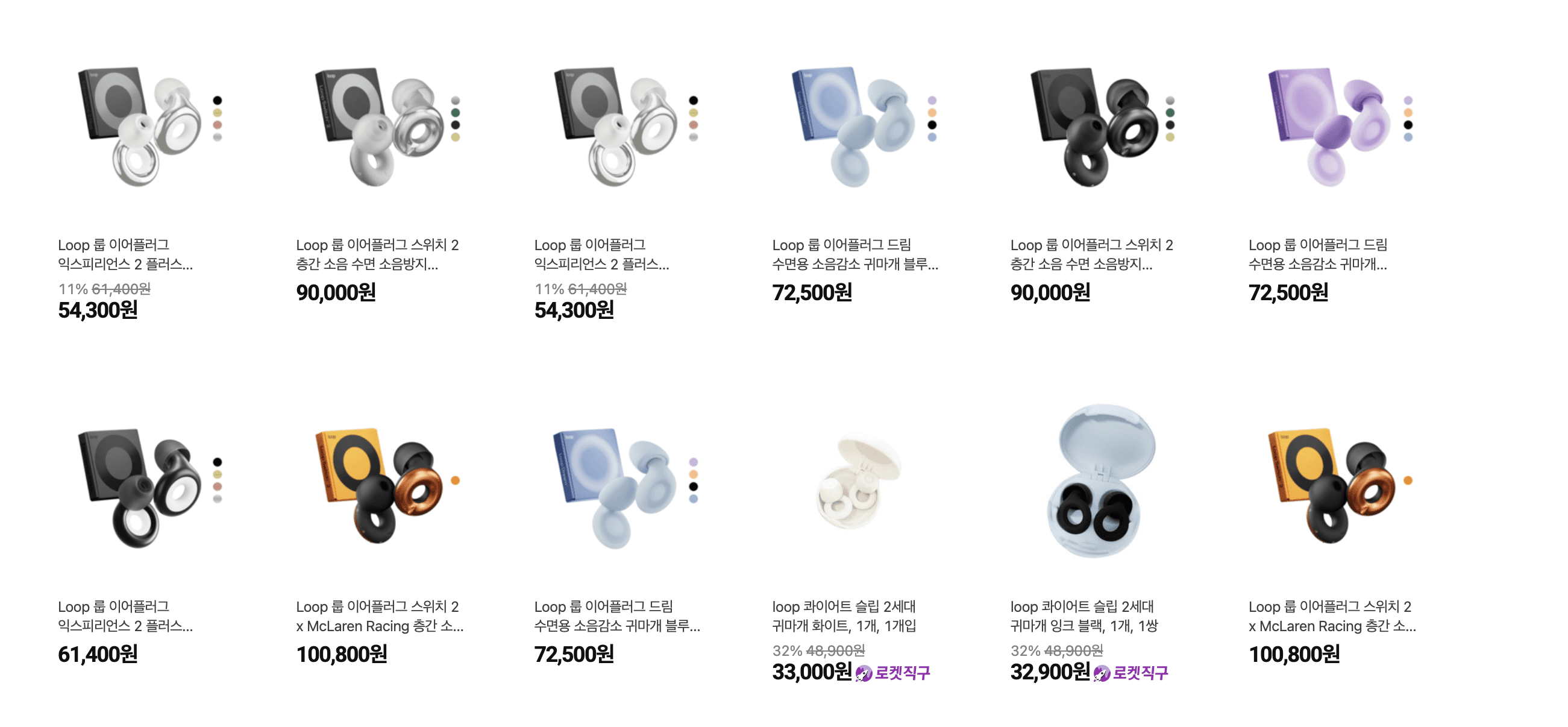
(caption) Still an outrageous price for an earplug, but when you consider they'll last for years, doesn't it start to tempt you? My wallet gave in at month three...
How Loop navigates this crossroads between fashion and function is what I'll keep watching as a marketer. So far, the brand has expanded successfully on a sharp value proposition and global reach, but whether it can keep growing for the next three years remains to be seen. If Loop doubles down on its Korean GTM, my personal suggestion would be positioning around education and studying. (Though Loop is such a hip brand that this would cut both ways.)
So that's the story of Loop, the brand that built something genuinely cool in one of the most boring categories imaginable and grew it explosively. Loop shows that even the most ordinary consumer product hides scalable potential the moment you redefine the problem it solves. Find an unsolved problem, sharpen it, start with vertical branding, then scale while raising both quality and price. It's textbook startup strategy. Of course, people half-jokingly say that after a decade of startup saturation, finding a truly "unsolved problem" is now nearly impossible. But still, is there a consumer product coming to mind right now that could be the next $220 million story?
Check Out Loop Earplugs
If my genuine favorite has piqued your curiosity, you can see the details on Coupang
*This post is part of the Coupang Partners program, and I may earn a small commission from purchases.
보나 로그 아티클 더보기